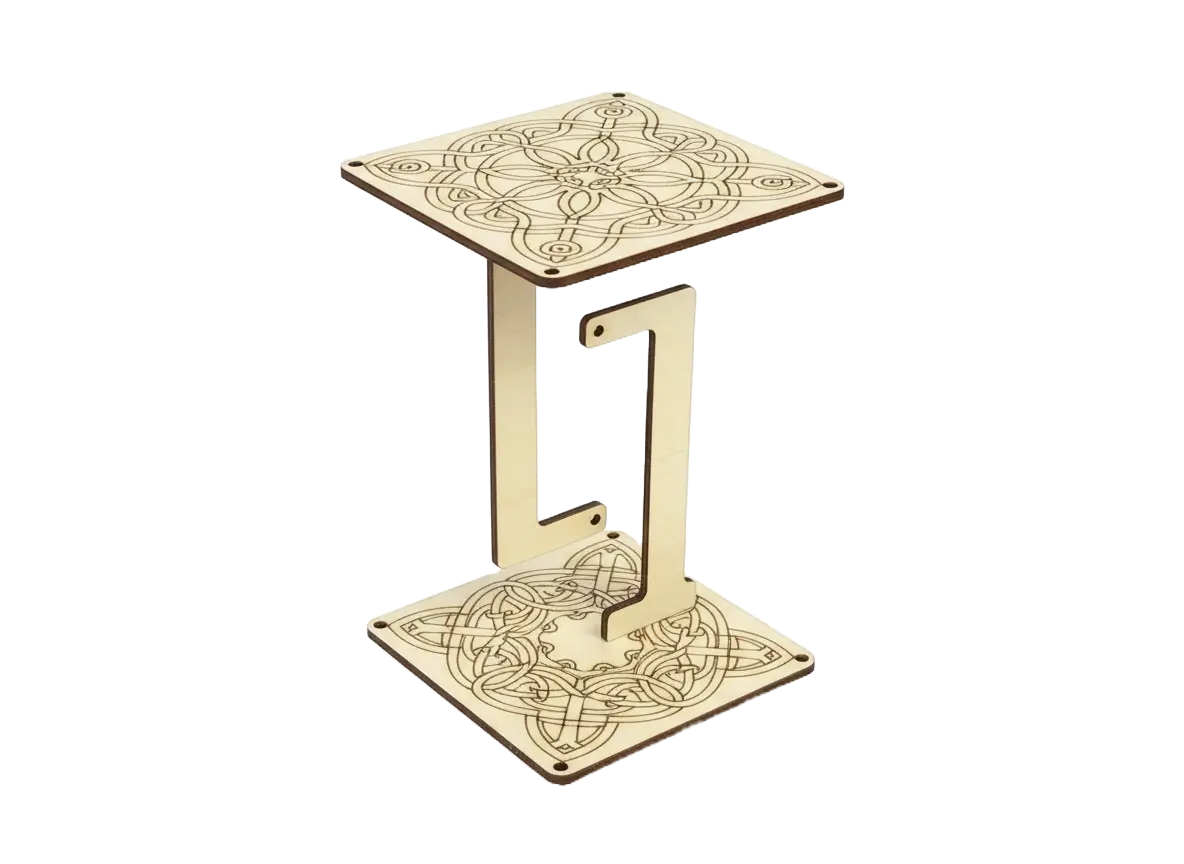
ntroduce a striking blend of engineering, physics, and modern design to classrooms, maker-spaces, or living areas with our MDF Tensegrity Table. Precision-cut from high-quality MDF and supplied with tensile cords and hardware, this table demonstrates a counterintuitive structural principle where isolated rigid members float in stable equilibrium because of tensioned cables. The result is a lightweight, eye-catching table that’s both a functional surface and a powerful hands-on STEM learning object.
What is tensegrity (deep explanation)
Tensegrity — short for tensional integrity — is a structural principle that combines compression elements (rigid struts) and tension elements (flexible cables or cords) so the compressive parts do not touch one another directly but are held in position by a continuous network of tension. In a tensegrity table:
-
The MDF struts serve as compression members. They are short, rigid segments that resist being squashed.
-
The cords (pre-tensioned) form a continuous tensile network that pulls the struts into place.
-
Load applied to the tabletop is distributed through the cords and into the struts, producing a stiff, stable structure even though the parts may appear to float.
Key mechanical ideas: pre-stress (the cords are tensioned during assembly), self-equilibrating forces (tension balances compression), and geometric stability (specific arrangement of members yields a stable shape). Because stability relies on a balance of forces rather than heavy mass, tensegrity structures are lightweight, shock-absorbing, and visually surprising.
How this product demonstrates STEM concepts
-
Statics & equilibrium: learners see how forces balance without continuous contact between rigid parts.
-
Materials & mechanics: compares stiffness of MDF struts vs. elasticity of cords.
-
Systems & design thinking: exploration of geometry, symmetry, and how small changes in tension or angles change overall stiffness.
-
Hands-on experimentation: change cord tension, swap strut lengths, or add small loads to observe real-time response.
Features & what’s included
-
Precision laser-cut MDF struts and tabletop panel (pre-sanded edges).
-
Pre-measured tensile cords and fastening hardware.
-
Simple assembly jig/template and illustrated instruction sheet explaining assembly steps and the science behind tensegrity.
-
Optional extra cord set for experiments (choose when ordering).
-
Finished table supports light to moderate loads suitable for display items, books, or small devices — great as a demonstration table or decorative accent.
Practical notes & care
-
MDF surface has a smooth finish; wipe clean with a dry or slightly damp cloth. Avoid prolonged moisture exposure.
-
Keep away from heavy or sharp objects that could damage the struts or cords.
-
Regularly check and retighten cords if experimental play includes changing tensions frequently.
Why choose this for STEM & décor
-
Doubles as a conversation-starting décor piece and an educational exhibit.
-
Encourages inquiry-based learning — learners are invited to hypothesise, test, and iterate.
-
Lightweight and transportable for classrooms, fairs, or makerspaces.
-
Elegant, modern aesthetic that fits contemporary interiors while packing real engineering lessons.
Safety & assembly
-
Recommended for ages 10+ with adult supervision for younger builders (contains small hardware).
-
Assembly takes approx. one guided session; instructions explain safe pre-tensioning techniques to avoid snapping cords.
-
All hardware rounded and designed for safe classroom use.